From Golden Age to the 20th century
The beautiful mansion on the canal that now houses The Toren, was first built in 1618 as a typical example of the grand townhouses of its time. The big mansions were used as homes and work places, with the basement usually reserved for the kitchens and servants’ quarters.
For the Netherlands, and Amsterdam in particular, the seventeenth century was a flourishing age better known as the Golden Age. Trade in spices with the Far East, now Indonesia, brought wealth to the city. On Herengracht and Keizersgracht huge houses were erected. Many of these houses on the canals were richly decorated and beautifully laid out. Nevertheless, the Dutch were sober people, wary of pomp and circumstance.
From 1830 to 1882 the house was in the hands of the Bienfait family, who had bought the house for NLG 13,000. The Bienfaits were descendents of the Huguenots who had been driven from France and had acquired their wealth in the nineteenth-century sugar import industry, for which they kept their own ships.
The most remarkable figure to have lived in the house was Abraham Kuiper, who lived from 1837 to 1920. He was the founder of the Dutch Antirevolutionary Party (ARP) and became Prime Minister for the Netherlands in 1901, after which he moved to The Hague. He was also a preacher and leader of the orthodox-reformed community in the Netherlands. He aimed to adapt Calvinism to bring it in line with the times, but based on its strict doctrines. He was also a journalist and writer of mostly theological and political treatises.
In 1880 Kuiper founded the VU University (VU), the second university in Amsterdam. It was the reformed answer to the University of Amsterdam (UvA), at a time when every religious-social movement had its own institutions. The Catholics, the socialists, the Protestants and the liberals all had their own associations, broadcasting stations, housing corporations and schools. Founding a reformed university represented a logical step at the time.
In 1889 the VU University bought the premises on Keizersgracht 164 for NLG 41,000. The adjacent buildings, numbers 160 to 166, also became part of the university. The 'Heerenkamer' (first door on the left after the stairs) was the so-called ‘sweat room’, the room where the exams were taken.
The entire first floor was dedicated to lecture rooms. The massive library was situated on the top floor.
In the Second World War the house was used as a safehouse. The twenty people, who were sought by the Nazis for a number of reasons, all survived the war.
In 1967 the building became too small for the ever-expanding number of students, and the VU University moved to Amsterdam Buitenveldert.
History The Toren
The Toren family bought number 164 in 1968. The four years before the family had run a Bed & Breakfast in the Van Breestraat, near Vondelpark. Mrs Toren still laughs when she remembers the times that she would drive her massive American car to Central Station to pick up potential customers. She would address tourists that looked as if they didn’t really know where they were going, and then drive them to their small hotel. Those times were over. De Toren family were going to make it big and they all moved to Keizersgracht…
The family, which comprised the parents and no less than five daughters and one son, used the VU’s former teaching room erected in the garden as their home.
The initial joy at their purchase paled a little when they thought about how to turn this huge building into a hotel. It promised to involve a massive amount of work turning the empty halls into hotel rooms. But they never gave up. Mr Toren wanted every room to be fitted with a shower and toilet, not a standard feature at the time.
The first guests helped decorate the rooms. Some brought curtains, and others painted the windows. This is how the first rooms were rented, and the doors opened officially on 15 March 1969. The overall renovation eventually lasted three years, resulting in 34 rooms and one star.
However, the family wanted to offer its guests more comfort and following a number of smaller renovations across the years, the hotel received its second star in 1978. In 1983 the second building (at number 146) was added, increasing the number of rooms to 45. In 1988 the intense efforts were rewarded with a third star.
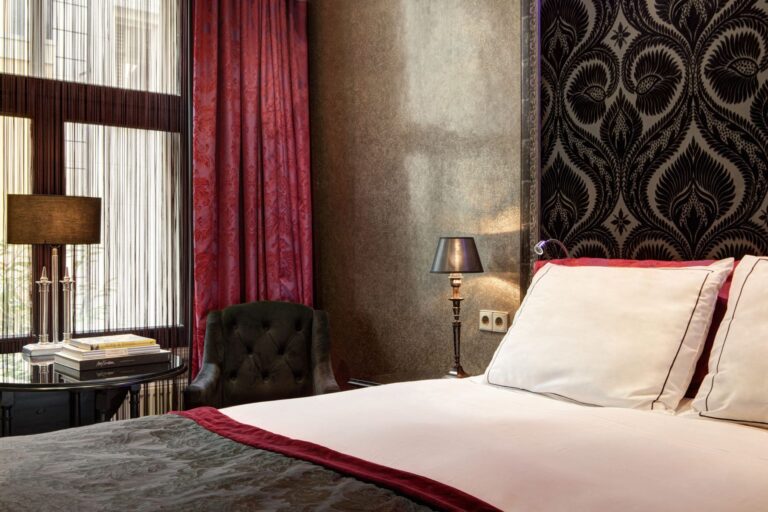
Eric Toren has led the hotel since 1991. Under his inspiring management, the hotel has become one of the most beautiful four-star hotels in Amsterdam.
For an impression of the hotel you watch our movie.